Some Observations About Drawing and Spirituality


By Corey Drieth
Published by Drawing Never Dies
Introduction
In 1960, while giving a lecture at the Pratt Institute, a young Frank Stella said that “There are two problems in painting. The first is to find out what painting is, and the other is to find out how to make a painting.” What I love about Stella’s statement is that it takes nothing for granted. He assumes as little as possible about painting and by doing so offers himself the opportunity to better understand painting’s history, and what is necessary and sufficient for an object to be considered a painting. Having a grasp of these things freed him from imperatives implied by the force of painting’s monumental history and allowed him to explore and expand its potential. I am similarly interested in the power of this kind of inquiry and have spent most of time over the last 25 years pursuing two such clusters of questions. The first: What is a drawing and what makes drawing special? In other words, what do drawings offer that no other mediums can? And secondly: What does the term ‘spirituality’ mean? And by extension, what is the difference between religion and spirituality? These questions are at the center of my life as a person and my practice as an artist and consequently inform the subjects I teach. Like Stella, my goal is to better understand what we mean when we talk about these common subjects, to take nothing for granted about them. Ultimately my hope is that by doing so, I begin to free myself and my students from some of the common assumptions carried within them and to open-up expanded avenues of personal and artistic exploration. So, rather than coming up with concrete answers, I prefer to develop working definitions, points of departure that help clarify and inspire further thoughts about both subjects.
About Drawing
When initially asking the questions ‘What is a drawing and what makes drawing special?’, the answer many of us start with is one that is most obvious; we define drawing by the most common materials used in making them, such as graphite, erasers, charcoal, paper, blending tools, etc. We also commonly define a ‘good’ drawing by how well an artist uses these materials to accurately represent the visible world around us (mimesis). Students regularly claim that they cannot draw because they cannot make drawings of this sort. Because of this – and for reasons too numerous to list here - these responses have never satisfied me. Ultimately, they have always seemed too reductive and limiting and don’t match how I feel when making and looking at drawings. Of course, understanding how these materials work and what kind of expressive opportunities they provide is important. And understanding the importance of observational practice for young artists can’t be overstated. But after thinking a lot about it and reading various essays about drawing from a variety of sources (the most influential to me being art writer and author John Berger’s work), I believe that unpacking the how of drawings is much more insightful than holding onto the what of them. In other words, I’ve become interested in exploring the connection between how drawings are made and how we experience them. The ‘how’ of drawing is often connected to their materials of their construction, style, and subject matter. But not always, and not necessarily.
Drawings, in their most basic form, are created by placing a mark on a ground. The most common form of mark is the line. But there are many others…dots, smudges, scratches, etc. This ‘figure/ground’ relationship defines what a drawing is at its most basic level. Humans have consciously left marks on surfaces for millennia, starting with petroglyphs and pictographs in places such as caves on the Indonesian island of Sulawesi and in the caverns of Chauvet in France. Further, babies first begin scribbling around twelve to eighteen months of age, approximately the same time they begin to speak. Scribbling and sound-making help babies understand the relationship between the self, others, and the world…the body in space and time. Almost all babies do this and as these activities develop alongside our biology, they become more complex. Marks begin to embody each maker’s unique physical action as it reveals itself in time. This is sometimes referred to as an ‘autobiographical mark,’ a person’s default style which is the initial way a maker searches for and creates personally meaningful form via drawing. These marks eventually become awkward representations, a kind of visual onomatopoeia, developing in parallel with language skills. And together they quickly become writing.
All the while, these marks continue to relate to the surface on which they are placed (as sounds relate to the silence between utterances). This surface ground forms a negative space that supports and defines the character of the mark, almost always playing a role in our experience as readers of drawings. Due to these qualities, drawings are the most naked form of 2-D art, where process, time, and underlying structure are revealed most clearly. Because they are the tool most often used to visualize ideas – translating internal images into material form - drawings are also associated with study/preparation for more finished works of art and often carry with them a provisional aesthetic. In addition, because of their demotic and democratic nature, and the inexpensive accessibility of its materials, drawings seamlessly allude to what traditionally has been called common or ‘low’ forms of making, such doodling, cartooning, graffiti, etc.
Regardless of status, drawings are typically original pieces of creative work. In the European/American tradition, Drawing as an art historical practice has its roots in mimesis. But there are ample examples of them being used in abstraction as well. To note, the oldest drawing made by modern humans is believed to be a cross-hatched symbolic abstraction, approximately 70,000 years old, found in Blombos cave in South Africa.
To round this out a bit further, it can be helpful to look at Drawing’s closest relative, Painting. In the European classical art making tradition, Painting is considered a child of Drawing (alongside Sculpture and Architecture); they are genetically related and share a lot of the same traits. This is because drawing has been and continues to be used in the initial development of painting. But instead of resting within marks on a ground as drawings do, paintings continue to be built up. Of course, some drawings are made in this way too,
especially through the application of thicker marks made by way of pastel or chalk. But in painting, this build occurs via fluid area, planes of merging color made via a viscous material (usually paint) that has both solid and liquid qualities. These areas are applied in layers and accumulate like geologic strata, at least partially obscuring what came before. Thus, surface quality and method of application become an indelible part of the language of painting and how it conveys meaning.
Unlike most drawings, the process of time unfolding in a painting’s creation is spread out and often subtle, if not hidden altogether. But it can be revealed, depending on its method of application and surface topography. Due to the complexity of this process, learning to paint - becoming familiar with what paint can and cannot do when applied to a surface - typically takes a great deal of effort and most people do not have the patience or proclivity for it. In the fine arts it has been considered a skill usually reserved for the preternaturally blessed or acquired by way of intense specialized training.
Due at least in part to the masterly sense of memetic refinement of paintings made from the Renaissance until the 20th century (and bolstered by the fact that painting materials have been, by and large, more expensive and less readily available than drawing materials), Painting developed a history of prestige within Europe, and this ethic was brought to the rest of world via trade and colonialism…their originality and uniqueness prized within growing markets. Subsequently, it has been the art practice most associated with ‘high art’ since that time. When looking at the market today, one could argue that it still is the most sought-after form. Whatever the case may be, over the last century, Painting’s role and status have changed; while retaining the currency of its history, it has also hybridized with other artistic formats, such as sculpture, installation, and performance art, to name a few.
Finally, I would also argue that painting’s prestige contributes to scholars categorizing certain pieces of art as painting and not drawing. One example is the prehistorical cave art mentioned earlier. Another is the Mimbres pot below.
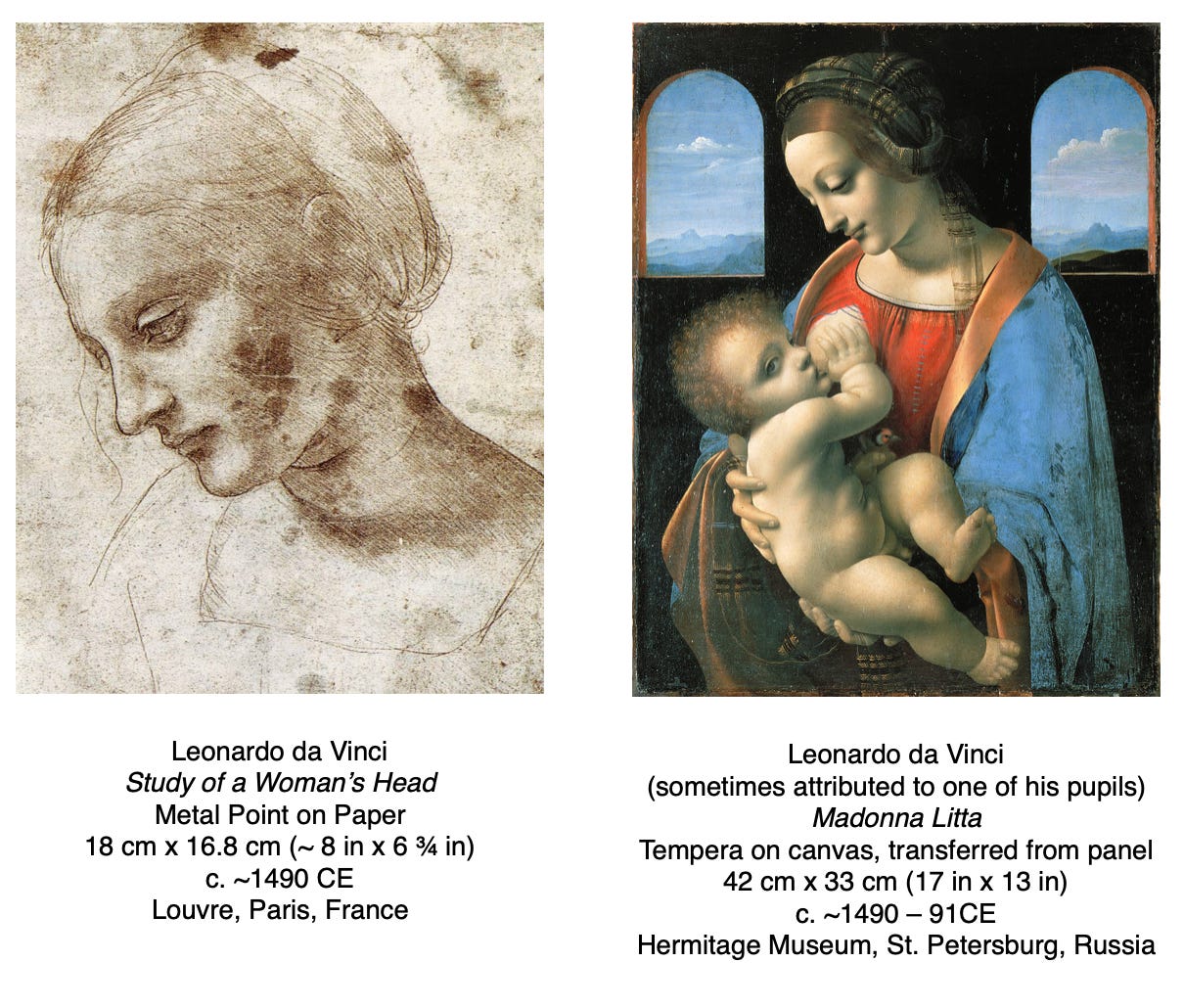
The drawing by Leonardo da Vinci, contrasted to a painting attributed to him, illustrates how drawings and paintings traditionally function:
About Spirituality
In his seminal book On the Strange Place of Religion in Contemporary Art (2004), James Elkins tackles several important questions related to art and religion in Modern and Contemporary art. In paraphrase, he says that while in the early 21st century there are countless examples of religious art across the world, there are very few examples of religious Modern and Contemporary art. He attributes this in part to the imperative of the 20th century Avant Garde, which was to question traditional authority and champion the new. He cites a few exceptions, such as Matisse’s Chapel in Vence, France. But he notes that such art is rare because religious art is sanctioned by religious authority and is used for institutional purposes, while serious fine art made during the Modern period was anathema to such directives. But he does introduce themes that would go on to define how Contemporary artists would come to tackle this issue. Specifically, he unveils a track many of us follow today, and that is to separate spirituality from religion. For Elkins, religion refers to “a named, noncultic, major system of belief.” He goes on to say that it “also means the trapping of such systems: the rituals, liturgies, catechisms, calendars, holy days, vestments, prayers, hymns and songs, homilies, obligations, sacraments, confessions and vows, mitzvahs, pilgrimages, credos and commandments, and sacred texts.” Spirituality, on the other hand, he considers to be its foil. He defines it as “any system of belief that is private, subjective, largely or wholly incommunicable, often wordless, and sometimes even unrecognized.” He continues, “Spirituality in this sense can be part of religion, but not its whole.” When teaching my studio class Spirituality in Contemporary Art, I begin the semester by asking students to develop working definitions of the terms spirituality and religion, and Elkins’ descriptions are almost exactly what they come up with too.
Since the publication of Elkins’ book (which was almost the only book available on the subject at the turn of the 21st century), the flood gates have opened and there have been many insightful and beautiful books produced that explore contemporary artists who address these issues. One of the most notable is Encountering the Spiritual in Contemporary Art by Leesa K. Fanning (2018). Of the many themes addressed in Fanning’s book, two of the most impactful to me are her explorations of qualities of spiritual experience, and her discussions about how contemporary artists often draw upon religious art and practice for the formal structure of their work. For instance, she says spiritual experience is characterized by feelings such as yearning, vulnerability, gratitude, serenity, ecstasy, mystery, etc. She says that it also can be experienced as transformative, as achingly beautiful, as compelling, receptive, embodied and/or empty (losing oneself of ego), and as part of religiosity but not bound by it. Elkins’ word for many of these qualities is numinous, an awe inspiring, overwhelming yet intimate experience, a sense of being an intrinsic part of something deeper and greater, something that words cannot fully describe. Again, when asked to talk about qualities of spiritual experience, my students provide a very similar list every time.
About Religion and Drawing
Below are three examples of drawing (what I consider to be drawing based on the working definition above) that occur within historical religious traditions. I present these because I think they also express qualities of the numinous, and thus are also spiritual:
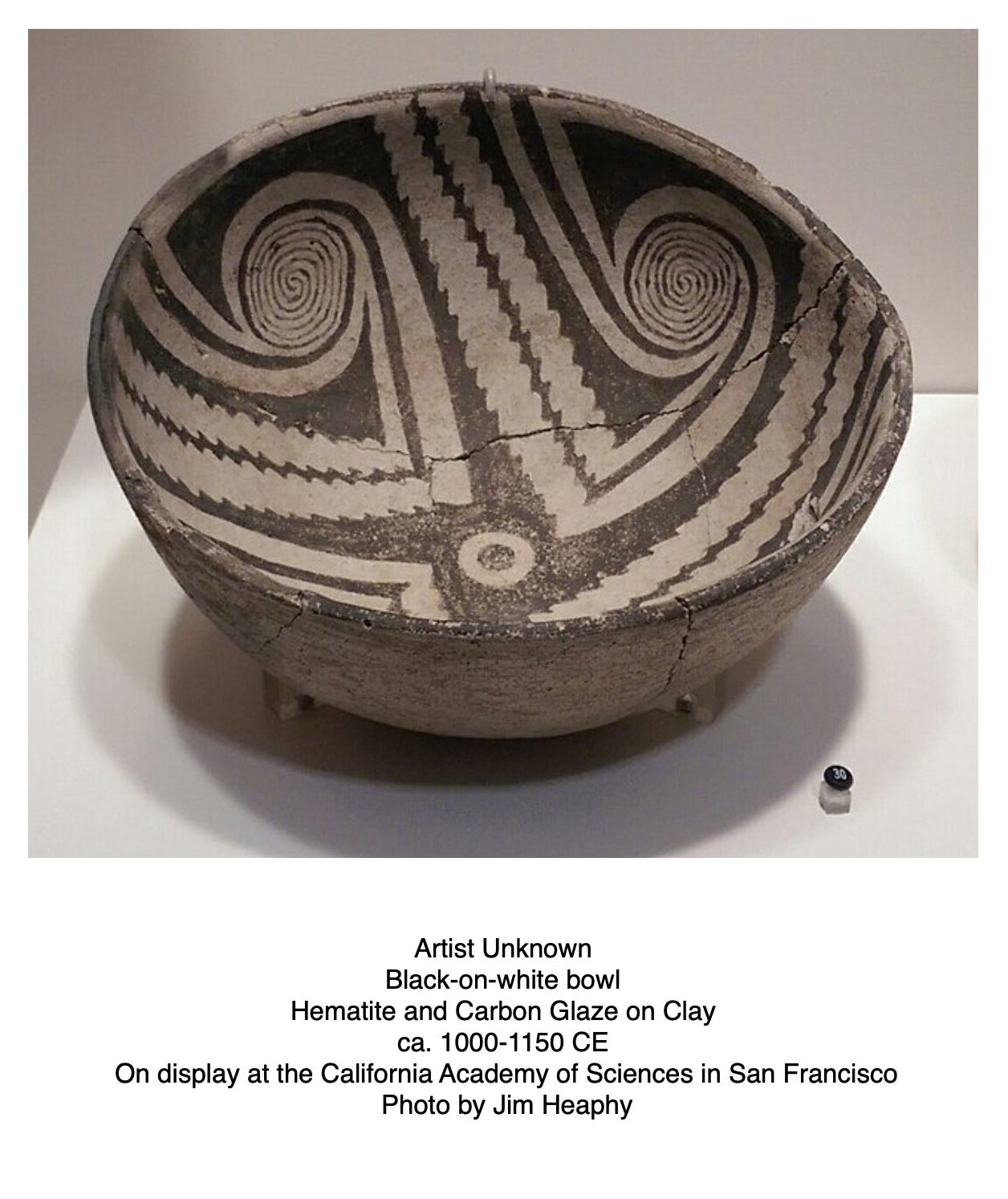
The dazzling graphic designs found in Mimbres pottery are widely considered some of the most sophisticated in southwest North American indigenous culture. Like Puebloan pottery today, Mimbres pottery culture is thought to have been matrilinear and, although the name of the artist who made this pot is unknown, it is believed to have been made by a potter of exceptional skill. The pots themselves were made with gray or tan clay, with white slip applied to the interiors. This slip forms a ground for the geometric drawings, designs made with a glaze produced from ground hematite and carbon and applied with a stylus/brush made from yucca leaves. These designs almost always only occur inside and not on the outside surface of the pots, which itself is left an unfinished bisque. This decision is telling, especially when considering that pots are aesthetically and pragmatically connected to our bodies: they have feet, bellies, sometimes necks, and mouths, and are used for survival and sustenance. The interplay of the shapes and lines within the concave body of the bowl above create dynamic positive and negative spaces that swirl, vibrate, and crackle. While there is uncertainty as to exactly how these pots were used in Mimbres culture, artist Tony Berlant and art historian/curator Evan Mauer, in their book Decoding Mimbres Painting: Ancient Ceramics of the American Southwest, say that the designs are likely entroptic, or representations of the common “brain generated shapes manifested in the eye” that occur after ingesting parts of the datura plant (moonflower) during religious ritual. They argue that these mind-expanding visions are hallucinatorily related to the significant flora and fauna of the Mimbres region, with a particular emphasis placed on the datura flower due to its significance in ceremonial life. For Berlant and Mauer, bowls like the one above use this pattern language to express the life of the datura…in this case as it opens its tightly wound petals at night to allow a visiting hawkmoth to uncoil its long proboscis to sip its nectar. To what extent these entroptic visions fueled the design language of the pots themselves, or the pots fueled the visions, is difficult to know. It was probably both. But the significance of the bowls to the Mimbres is clear by their formal sophistication and their placement within domestic burial sites.
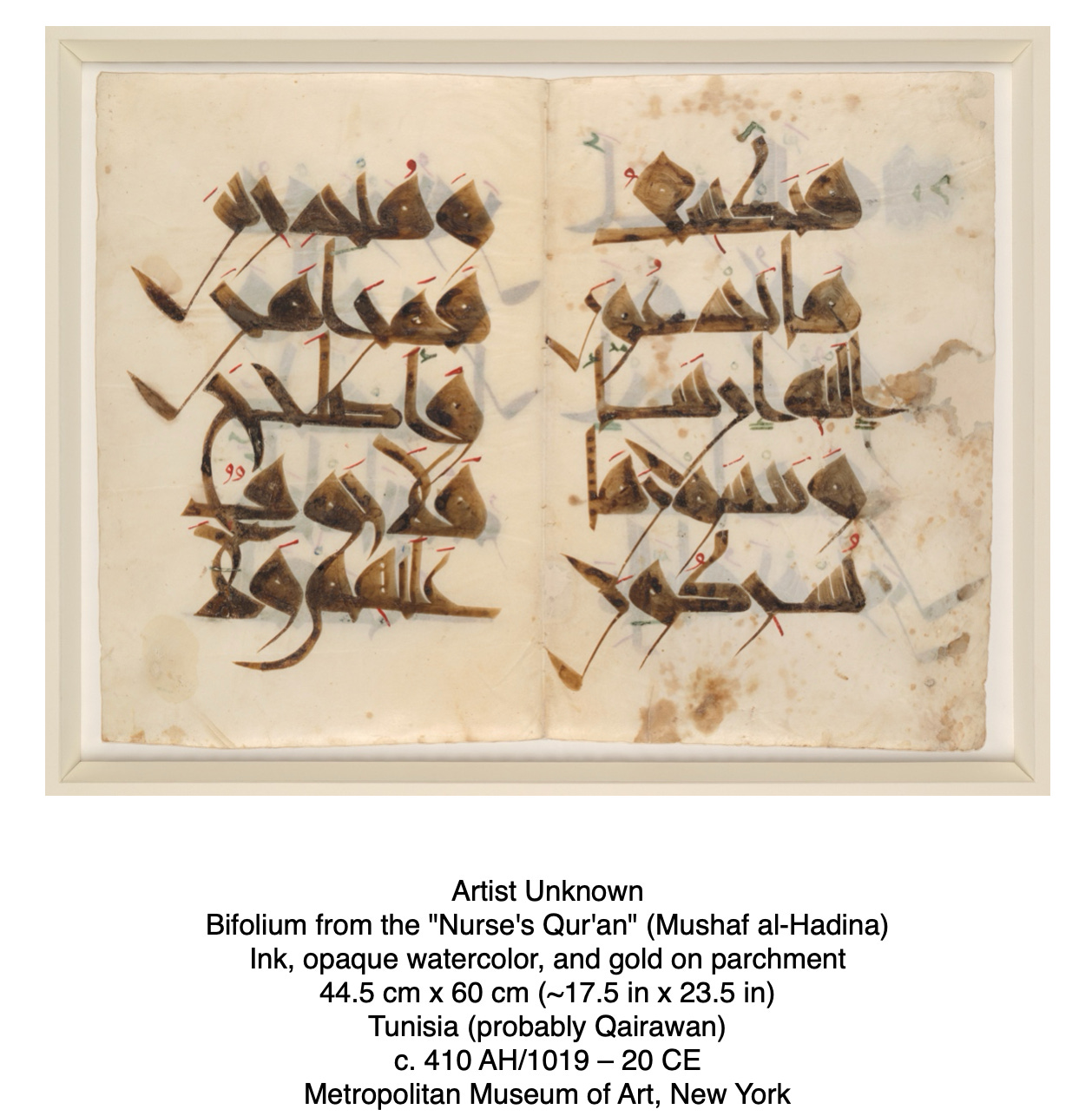
The ancient and well-known Sufi saying “Calligraphy is the geometry of the spirit” is at the heart of Islamic drawing practice and has been throughout its history. The miracle at the center of the religion is Allah’s revelation of The Word to the illiterate prophet Muhammed, and the Qu’ran is its physical incarnation. Through the act of ritualistically transcribing and re-transcribing it via beautifully stylized calligraphy, Muslim artists praise and participate in this sacred imminence.
Devotees benefit from this transcription as well, both by looking at the calligraphic forms and by reading them, either out loud or quietly to themselves. For the writer and reader, the abstract shapes of the characters are just as important as what they signify as language, their form being vital to bestowing Baraka, or blessings, to the devotee. While Renaissance strategies for creating naturalistic space such as linear perspective come from similar geometric principles, memetic representation of that kind is sacrilege for Muslims. Human beings are not meant to mimic God’s work as it is experienced in the outward form of nature. Instead, we are encouraged to celebrate the harmonious geometry within and radiating from it. By way of the complex, musical patterns of calligraphy (consisting of numerous stylistic traditions containing an almost infinite number of nuanced variations), prayer/song, dance, crafts, and architecture, Muslims glorify Allah and their place within creation. In the book above, the rhythmic, semitransparent pattern of the characters hover on the page, while the previous and following pages lay underneath, almost like palimpsests…a voice given physical form, echoing from the past into the present and projecting into the future.
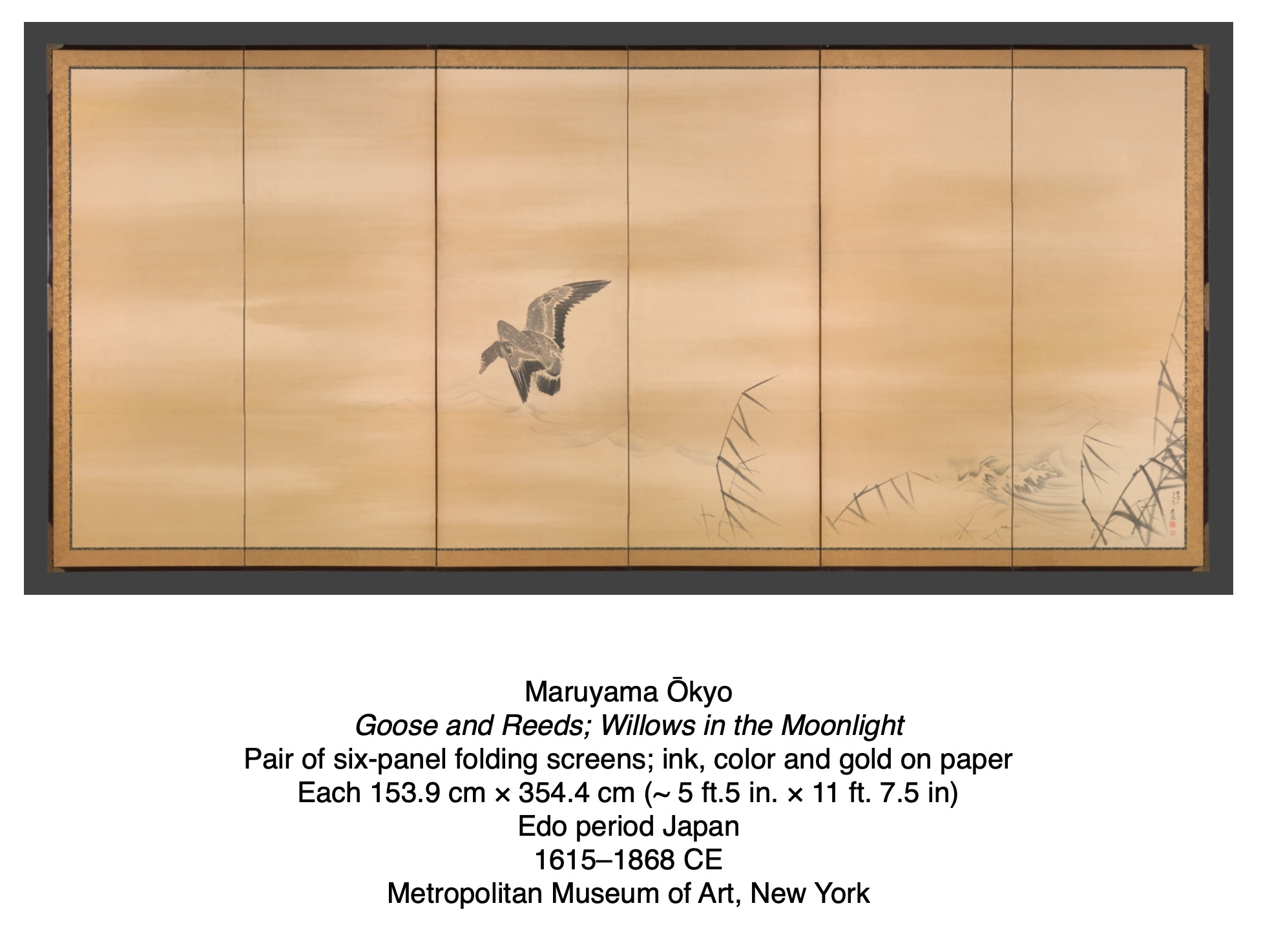
In the Chan/Zen Buddhist traditions of Korea, China, and Japan, drawing is used calligraphically and as stylized representation. Its purpose is to celebrate the poignant, luminous, ever-changing world, something Japanese Zen Master Dogen (1200-1253 CE) called the “One bright pearl” of existence. Like Haiku, images such as this one rely on an economy of means, including an emphasis on negative space/empty ground, to expressively achieve their goals. Note that this piece is made of relatively large screens that directly relate to the size of our bodies. Within interiors, screens like this bisect space. Moving across this screen from right to left - as it is meant to be read - helps draw out the passage of time embodied in it. As we contemplatively walk alongside it, we notice that we are slightly above a shore lined with reeds. Suddenly we surprise a goose resting there. We are surprised too, and we forget ourselves. But in a moment, the goose is gone, disappearing into the mysterious, misty deep space of the moonlit lake.
Within this visual narrative lies the Buddhist notion of Satori, an experience where ego awareness suddenly opens to the greater interconnected, ever-changing world. This paradigm shift relates to the Sanskrit word Śūnyatā (Kū in Japanese), often translated as ‘impermanence’ or ‘emptiness.’ Both ideas are embedded in the very design of the work via its quick but adept brushwork, its asymmetrically balanced use of positive and negative space, and its visual movement. Like the Mimbres pot and Islamic codice above, this work is active; experiencing it manifests deeper core spiritual values articulated within the tradition.
About Spirituality and Drawing
After having conversations about religion and spirituality and the history of Modern and Contemporary art with my students, I ask them to make art that explores their personal experience of the spiritual. They can use any media they want and take any approach towards the theme that they want, including being critical of the concept. The only restriction is that they can’t make overtly religious art, or art that obeys religious aesthetic conventions. In parallel to contemporary practice, I want them to make work that explores their personal experiences first and foremost, to trust their own stories. However, using Elkins’ and Fanning’s books as cues, I also encourage them to borrow from formats found within the religions closest to them to increase the associative complexity of the work they make. The examples below illustrate how a few of my former students, who are now working artists, have addressed the theme of spirituality by way of drawing. Like many college students in the US, all three were raised in Christian traditions. Some still identify as Christian. Others have expanded their quest to include other forms of religiosity such as Taoism. All continue to make work about the role of spirituality in their lives.
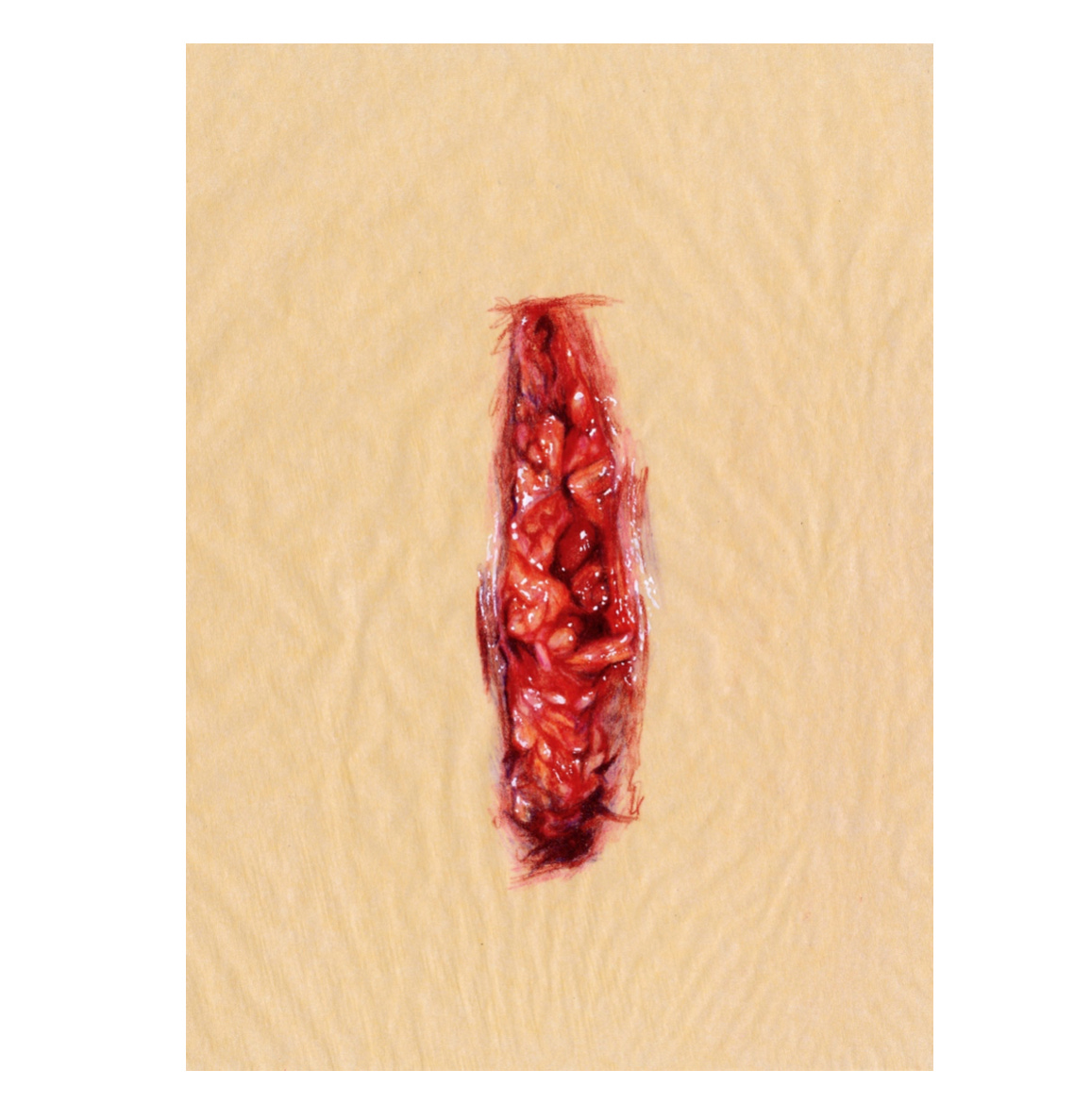
Jonah Brock’s current work is centered on the body in distress, and he approaches it from a wide variety of media and processes, including drawing, painting, video, sculpture, performance, and writing. He is inspired by religion, psychoanalysis, horror films, and the vernacular of the subcultures of which he is a part. In his artist statement he says:
“I’m interested in queerness as a site of the uncanny, and the anxiety and fascination surrounding transgender identity. Pairing the transsexual and/or disabled body with surreal imagery, my work calls to monstrosity, intimacy, loneliness, and the divine.”
In Wound #4, Brock draws from video stills of surgeries and autopsies as source material to intimately explore a wound. Using ink and graphite, he meticulously and intimately renders this lesion. At its edges, the drawing’s provisional quality is most clear. His marks are charged with aggressiveness as they search out form. As the drawing develops towards the center, it becomes much more refined and softer, articulating moist, blistering viscera that is attempting to spill from the edges of a cavity.
This drawing is made on delicate, semi-transparent tracing paper, paper that starts to wrinkle slightly due to his use of ink. He overlays it on gold iridescent paper so that warm light subtly filters through. This process gives the ground of his drawing a luminous, fleshy quality, a ground that somehow both supports and sinks below the highly detailed drawing of the wound. It is a contemporary stigmata, an illustration of the divine made incarnate. But this laceration is also isolated, as if being clinically and forcefully examined. Like most powerful contemporary art, we are left without clear answers, marveling at the luscious beauty and grotesque pain embedded in it.
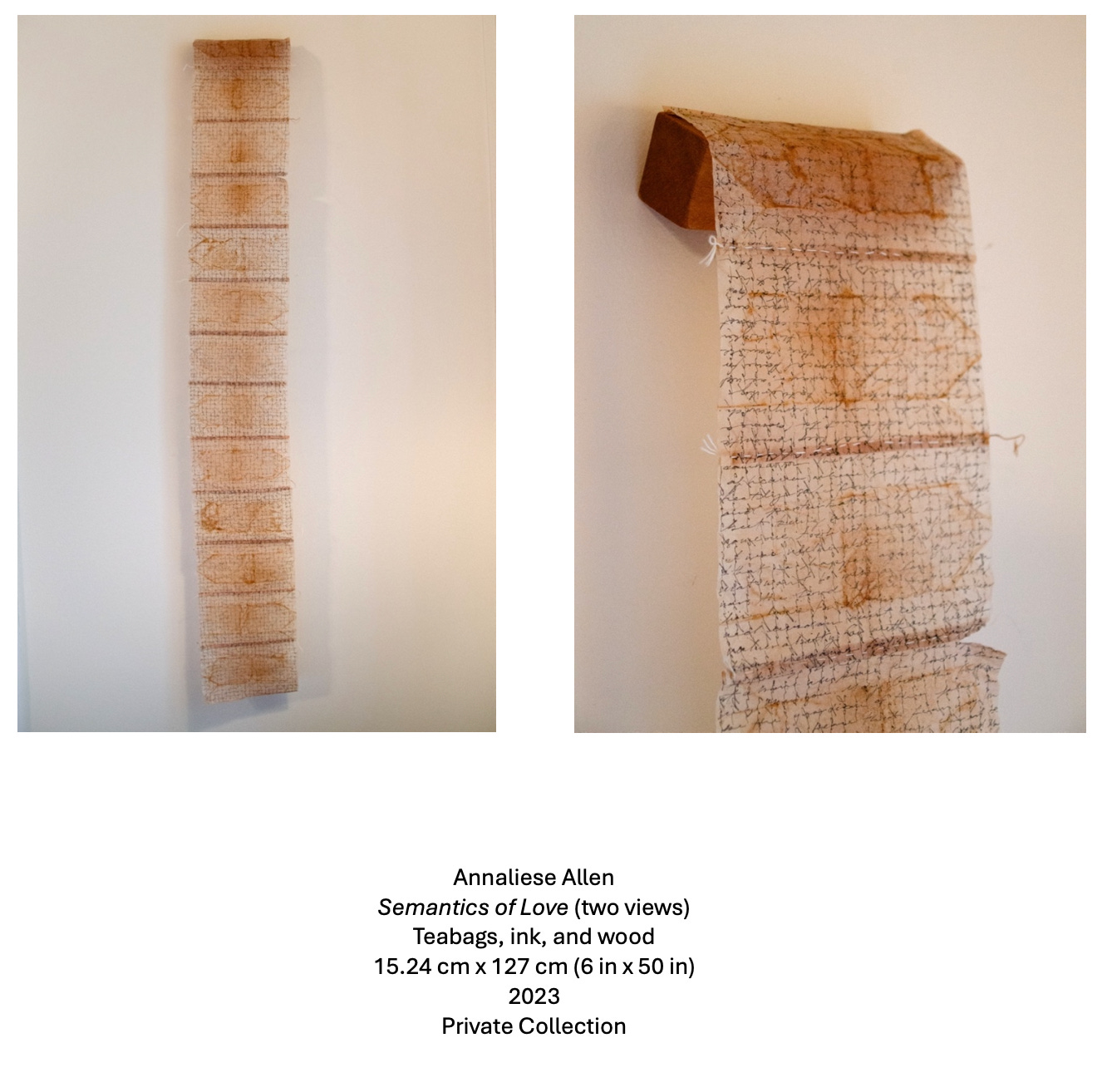
Like Brock, Annaliese Allen also uses multiple formats and materials to explore her subjects, including drawing, collage, assemblage, fibers, sculpture, installation, and sound. For her, humble materials are imbued with sanctity and meaning, and she uses them poetically, combining them in ways that invite viewers to indirectly participate in a rich, warm, earthy, experience of the sacred. For Semantics of Love, she applies a cursive form of asemic writing that is drawn in elegant cross hatch over used tea bags collected after visits from family and friends and then stitched together. Asemic writing is a form of drawing that resembles writing but is wordless and has no discernable semantic meaning. When discussing this piece, she references her interest in Christian monastic contemplative practices that use reading and looking to bring us closer to God. In her statement she writes:
“I love the practice of lectio divina, a form of meditation on the Scriptures. It is a practice that has been carried out for centuries by Christians. Semantics of Love, a delicate, scroll-like work, marries my love of asemic-style writing and my own lectio divina practice. Alternating between transparency and opacity with cross hatched writing, there is an invitation for the viewer to participate in visio divina, connecting antiquity to the present – encountering the divine through imagery.”
In this drawing, ultra-fine mark making on stained tea filters becomes gently paradoxical: it forms the mysterious warp and woof of the unfurled scroll, and the ineffable language for interpreting that weaving.
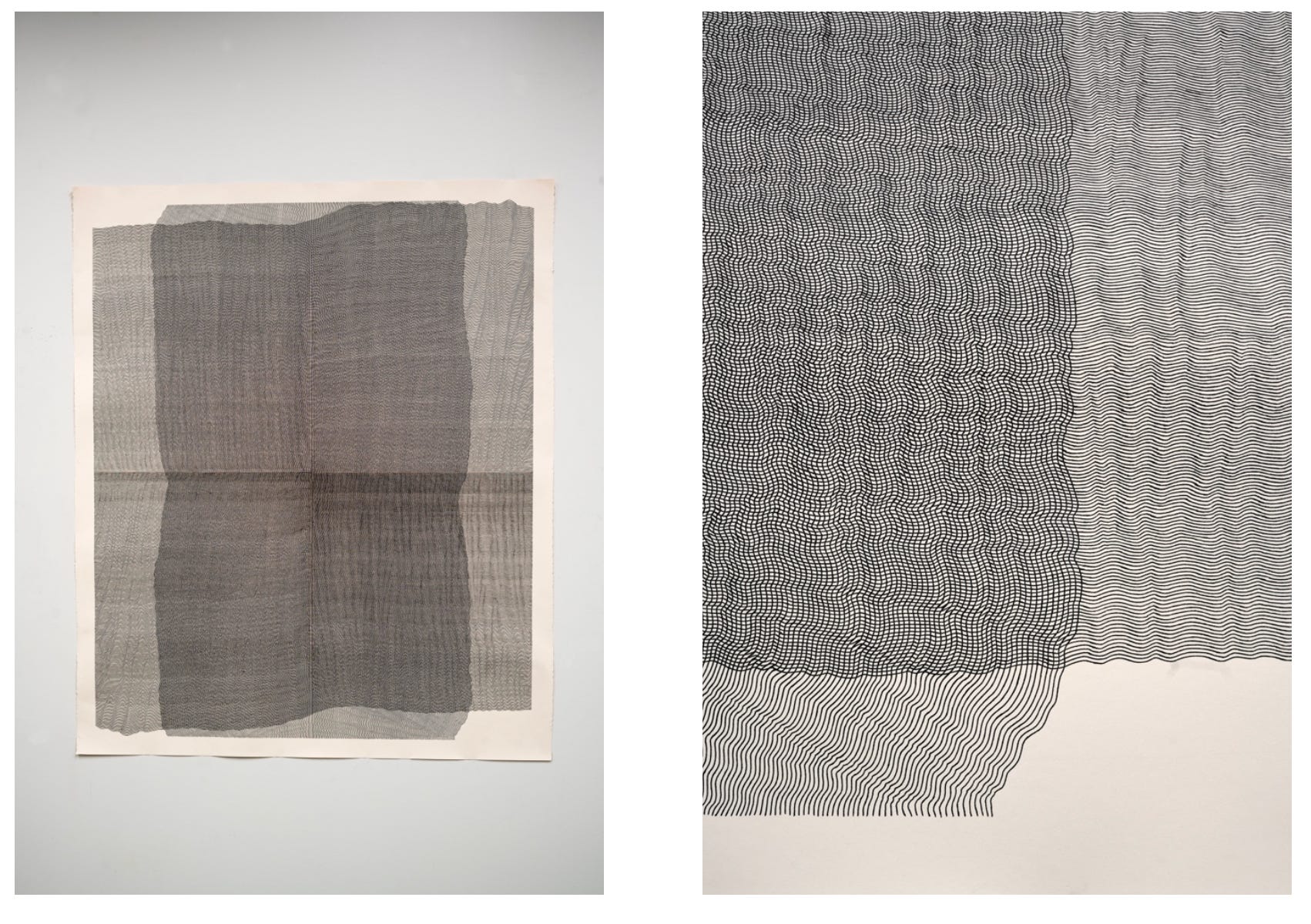
Clark Valentine’s drawings are like Allen’s in that they are laborious, contemplative, and reference textiles. But the meaning of his work is centered in process rather than materiality. In pieces like Weaving no. 7, he repeatedly draws slow, wavy lines in permanent black ink that run parallel to one another across a large surface. This act leads him to a transcendental meditative state, a state he seeks. His process begins with an initial ox-bowing line that moves horizontally, vertically, or diagonally across the surface. After he draws the initial line, he conscientiously draws another parallel to the first, attempting to follow the movement of the one which preceded it. Despite his attempt to mimic the earlier line, each new line takes on a slightly different personality via its unique width and density. As a result, the negative space between the lines quiver, subtly shrinking or expanding along their route. This slow, organic metamorphosis continues across the ground as the lines continue to parallel, creating the illusion of a wrinkled topography. He then applies a similar field of lines along the opposite axis. When the second field is finished, it overlays across the first, and the overlap deepens in value, forming a third cross-hatched space. This third space seems to be a loosely stitched, gauzy muslin that fractures the ground of the drawing into a sparkling mosaic of hundreds of tiny, torqued rectangles of negative space. His artist statement reads:
“My mark-making practice transforms drawing into a form of active meditation, where each gesture becomes both a physical action and a spiritual inquiry. Each drawing traces the evolution of repetitive, ritualized actions over time, revealing how the disruptions of the hand create unexpected compositional developments. The works demonstrate my journey towards moments of stillness, where conscious intention dissolves into intuitive response.”
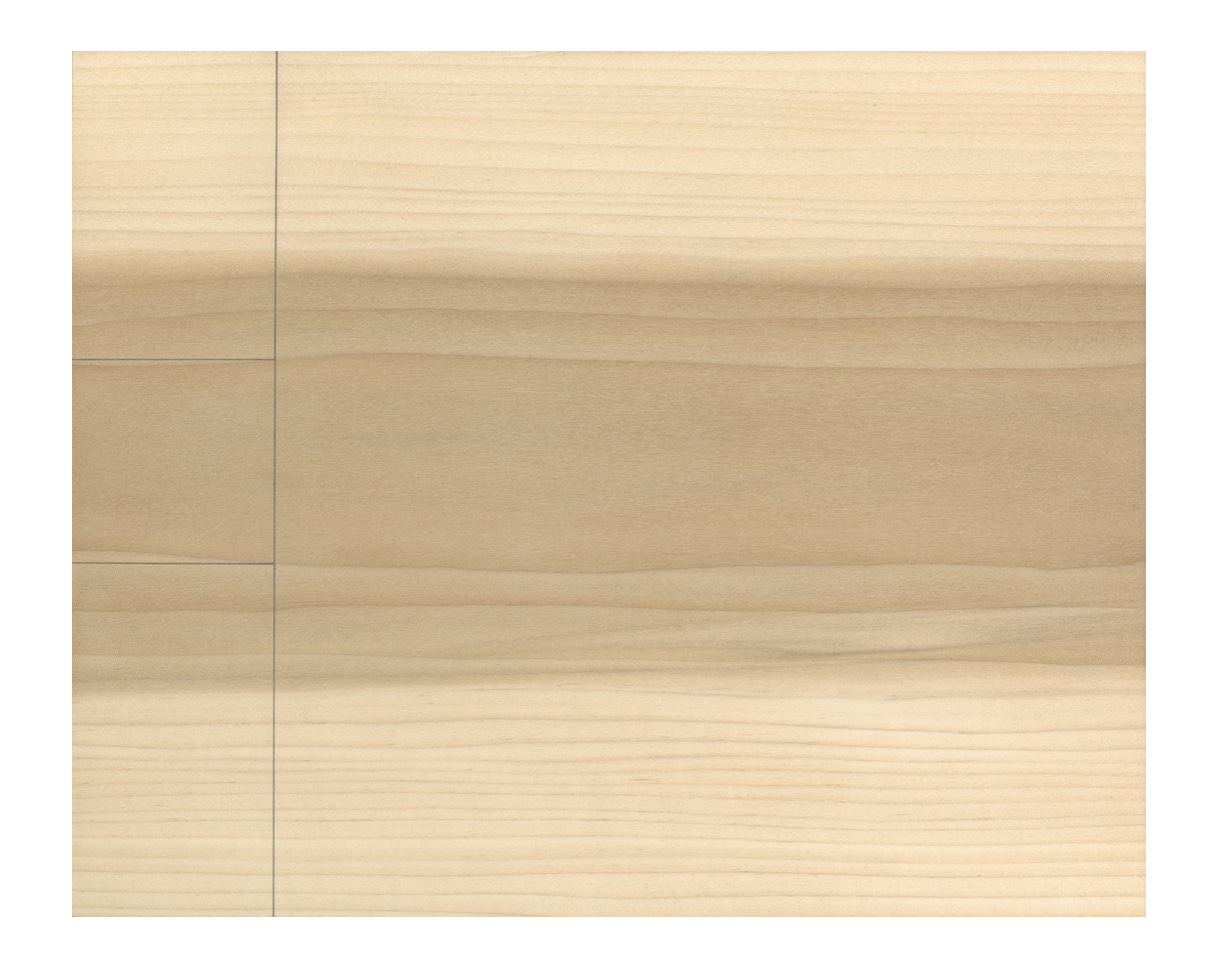
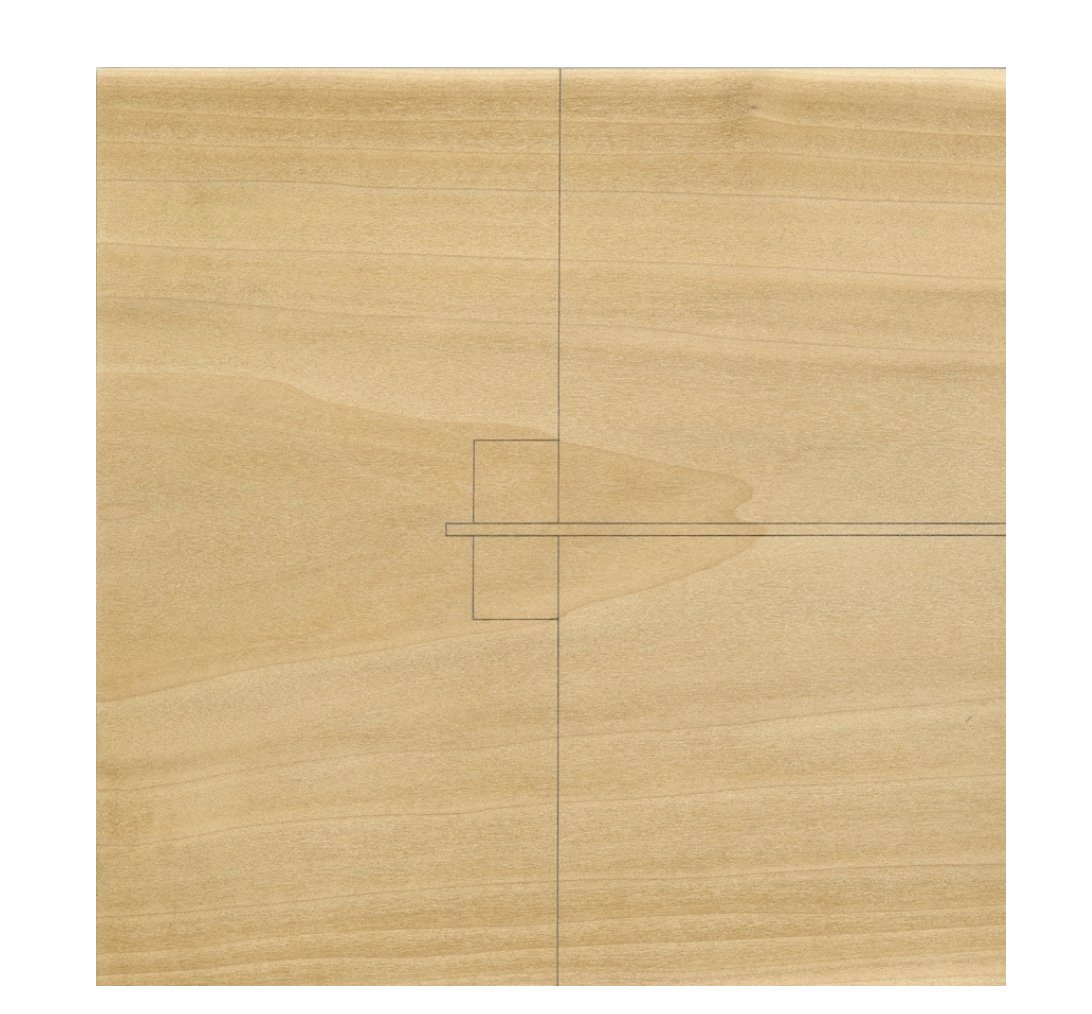
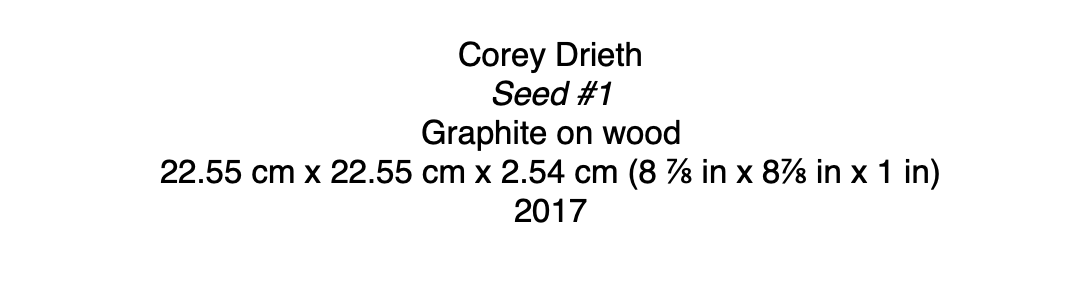
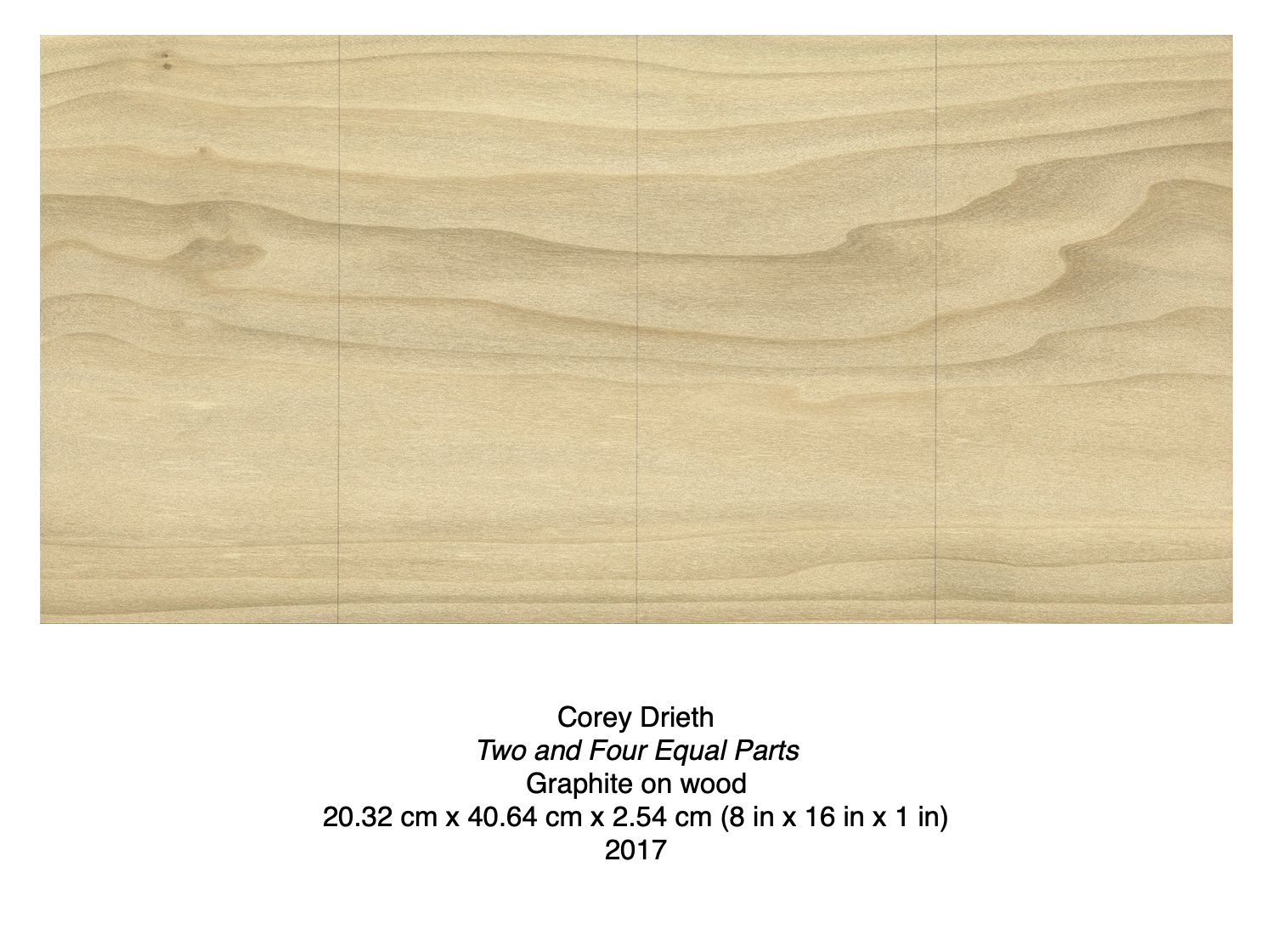
One of the most interesting intersections between drawing and spirituality I have encountered is in the Italian concept of Disegno. During the Florentine Renaissance, ‘disegno’ was a word that referenced both drawing and design; because drawing was so integral to understanding the structure of nature and composing it as art, this term came to refer to both. Yet for many artists, it also became sacred practice: it was a path to God by way of apprenticing with creation, by studying divine draftsmanship. In many ways it was the epitome of the Christian humanism that defined the era. After learning about this idea, I became fascinated by the notion of drawing as genesis, the first step in both expressing internal ideas and understanding our relationship with the external world. This was particularly interesting to me because this act wasn’t only related to artmaking. It extended everywhere, to drawing a map on the back of a receipt for a lost stranger, to scribbling obnoxious limericks in a public bathroom stall, to removing condensation on bathroom mirror with a finger. Personally, it related to experiences I had when I was a boy, watching my father prepare wood for carpentry projects. In the beginning he would make simple drawings on paper. Then, by way of a ruler and pencil translate those drawings onto wooden boards. I was mesmerized by how his simple graphite lines demarcated space, especially on the wood; in collaboration with its grain, they created a grammar for a future articulation.
With those memories in mind, I started a series of disegno drawings which, like my father’s, can be read as a compass and a map, directions for work yet to come. But like the sacred notion of Disegno, they also seek communion through a subtle and tentative harmony between synthetic taught, hard lines and the soft organic heart of their poplar supports.
Conclusion
As I conclude this essay, I am reminded of how well-suited drawing is for exploring the theme of spirituality. When considering what makes it special, I always come back to the autobiographical mark on a surface. Drawings are indexical signs of the maker’s thoughts, values, and vision at the time of their making. Further they are generative; they reveal form as it evolves and devolves. Mistakes are difficult to hide when drawing. Successes hard won. Both drawing and spirituality (within religion and outside of it) are defined by a similar kind of bare-boned searching, an honest, immediate seeking characterized by the attempt to discover and/or make something meaningful out of emptiness. The search in drawing begins with a personal mark and moves outward into the world to create structures of meaning…whether that be by writing in a journal, sketching a study for a painting, designing a sculpture, developing a story board, making a scientific illustration, etc. It moves back again too, sometimes erasing structures into the ground from which they arose. The same can be said of spiritual experiences as they move from their sublime immediacy out into religious institutions and back again. At the risk of being too grandiose, I would even go so far to say that the metamorphosis of the figure on a ground is a fundamental existential state, one we all find ourselves in when we are quiet and courageous enough to be honest with ourselves. It is a voice calling in a wilderness, an act revealing our longing for connection and meaning. John Berger, in an essay he wrote about trying to draw his dead father before he was buried, says:
“To draw is to look, to examine the spectrum of appearance. A drawing of a tree shows, not a tree, but a tree being-looked-at…This is how the act of drawing refuses the process of disappearances and proposes the simultaneity of a multitude of moments.”
To draw is to make marks that display the personal struggle to create meaningful form against the larger backdrop of inevitable disappearance. It is one of our earliest and most profound steps in this struggle. It is something we have always done and will always do. And that cannot be said of any other form of art.
 | A guest post by
|
Perfect timing. Yes, let's debug the definitions!